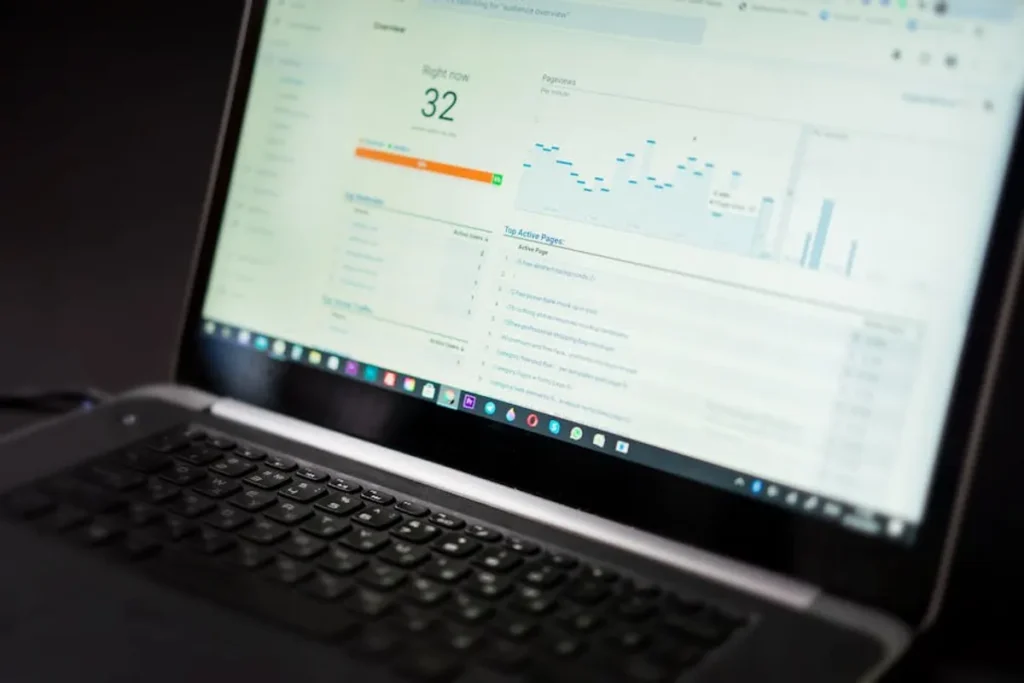
An algorithm update volatility tool shows when Google’s search results are behaving abnormally, so you can separate a site-specific ranking problem from broader SERP turbulence. For SEOs, publishers, agencies, and in-house teams, the practical value is speed: instead of guessing whether a rankings drop came from technical issues, content decay, or an update pattern, you can compare your movement against market-wide volatility signals and react with better context.
What an algorithm update volatility tool does
The tool tracks ranking movement across a large keyword set and converts those shifts into a volatility signal. When the signal spikes, it usually means the SERPs are being reordered more aggressively than normal. That can happen during confirmed updates, unconfirmed tremors, vertical-specific adjustments, spam actions, local result reshuffles, or changes to how Google blends features like forums, videos, product grids, and AI-driven elements into the page.
For day-to-day analysis, the tool helps answer four immediate questions:
- Is today’s ranking movement unusually high compared with the recent baseline?
- Is the turbulence broad across industries or concentrated in a few sectors?
- Did the shift begin suddenly, or has instability been building for several days?
- Are your losses likely tied to a wider update pattern rather than an isolated site issue?
On SERP Volatility, that matters because the goal is not just to show movement, but to help interpret unstable results in a way that supports faster diagnosis and better reporting.
When to use the tool
Use an algorithm update volatility tool any time rankings move enough to affect traffic, lead volume, or revenue. The strongest use cases are not limited to confirmed update days. In practice, many of the most useful signals appear before official confirmation, between update waves, or inside specific result types where turbulence is visible long before the wider SEO community agrees on what changed.
Use it during sudden ranking drops or gains
If your tracked terms fall sharply overnight, check volatility before changing pages, titles, internal links, or templates. A broad spike across the market suggests patience and observation may be better than rushed edits. The same applies to sudden gains. If visibility jumps during unstable SERPs, you need to know whether the improvement is durable or simply part of a temporary reshuffle.
Use it after major site changes
When a migration, template release, content consolidation, or indexation fix overlaps with a volatile period, attribution gets messy. The tool helps you distinguish between changes caused by your deployment and changes caused by broader ranking instability. That prevents teams from over-crediting or over-blaming internal work.
Use it for client communication and executive reporting
Agencies and in-house leads often need to explain why visibility changed before root cause analysis is complete. Volatility data gives stakeholders immediate context. Instead of saying “rankings are down,” you can say “rankings are down during a market-wide turbulence event affecting multiple sectors, so we are validating whether this is systemic or site-specific.” That is a more credible and commercially useful update.
How to interpret volatility signals correctly
A spike does not automatically mean your site has been penalized, and a calm day does not guarantee your site is healthy. The tool should be read as a context layer, not a standalone diagnosis. Strong interpretation depends on comparing the volatility signal with your own keyword groups, landing pages, devices, countries, and SERP feature exposure.
High volatility with broad market impact
This usually indicates a larger algorithmic event or a meaningful recalibration in result ordering. If your site declines during this pattern, first check whether losses are spread across categories or concentrated in one content type. Broad losses during broad volatility often point to update exposure. Narrow losses may still indicate a site issue hidden inside a noisy market.
High volatility in one vertical
If instability is concentrated in sectors like health, finance, ecommerce, news, or local, the update may be testing relevance, trust, freshness, or result format weighting in that niche. This is where vertical segmentation becomes commercially valuable. A general market average can miss the fact that your industry is in the middle of a much sharper reshuffle.
Repeated tremors without a confirmed update
Not every meaningful shift arrives as a single dramatic event. Sometimes the pattern is several days of elevated movement, partial reversals, and renewed instability. That often signals rollout behavior, quality system recalibration, or ongoing experimentation in how Google assembles the page. In these cases, trend persistence matters more than one-day spikes.
What to check alongside the tool
An algorithm update volatility tool works best when paired with page-level and query-level analysis. Once the signal shows instability, validate what actually moved on your site.
Review query intent changes
Look for terms where Google has shifted from informational pages to commercial pages, from brand results to publisher results, or from static listings to richer SERP features. Ranking drops are often caused by changed intent matching, not just weaker page quality.
Check feature displacement
If videos, discussions, shopping modules, local packs, or AI summaries take more space, traditional organic positions can lose clicks even when rankings appear stable. Volatility in feature mix is often as important as volatility in blue-link ordering.
Segment by page type
Compare category pages, articles, tools, location pages, and product pages separately. Update impact is rarely uniform. A site may lose heavily on editorial content while commercial pages remain stable, or vice versa.
Short workflow example
At 9 a.m., an agency notices a 14% visibility drop across a publisher client. The team checks SERP Volatility and sees elevated turbulence beginning late the previous evening, with stronger movement in news and informational queries. They then segment the client’s losses by page type and find that evergreen guides fell hardest while breaking-news pages held. Next, they review affected queries and confirm that forum threads and fresh-result modules are appearing more often. Instead of rewriting pages immediately, they document the update pattern, monitor for 48 hours, and prepare targeted recommendations around freshness signals, content maintenance, and SERP feature competition.
Why teams use SERP Volatility for update monitoring
The commercial advantage is not just knowing that rankings moved. It is knowing how to interpret movement before making costly decisions. A volatility tool supports calmer triage, cleaner attribution, and more defensible reporting when search results are unstable.
Practical benefits include:
- Faster separation of market-wide turbulence from site-specific issues
- Better timing for audits, stakeholder updates, and recovery analysis
- Clearer visibility into update patterns across sectors and result types
FAQ
Does high volatility always mean Google released a confirmed update?
No. High volatility can reflect unconfirmed adjustments, feature reshuffles, testing, or vertical-specific turbulence before any public confirmation appears.
Can the tool explain why my site dropped?
It provides context, not a full diagnosis. Use it to confirm whether the environment is unstable, then combine that signal with page, query, and technical analysis.
How often should I check an algorithm update volatility tool?
Daily is useful for active monitoring, but it becomes essential during traffic swings, major deployments, and periods when search results look unusually unstable.
Is volatility data useful if rankings went up?
Yes. Gains during turbulent periods may be temporary. Volatility data helps you judge whether the improvement is likely to hold or needs closer validation.